Rule The Globe Nukes Guide
Save, launch, and follow up strategic strikes without treating nukes like a free win button.
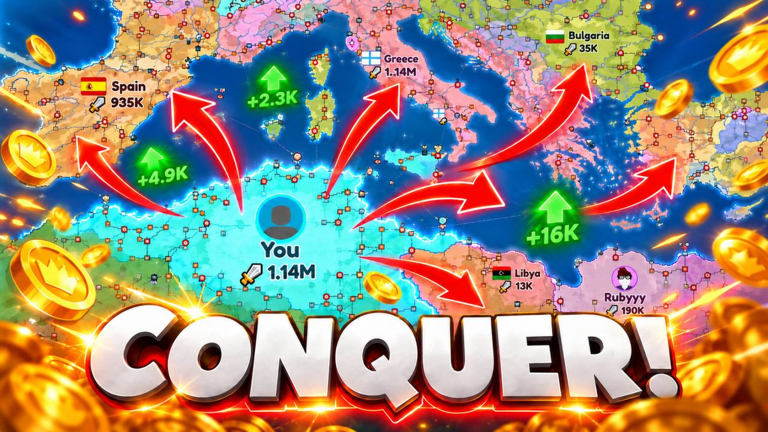
Nukes are the loudest tool in Rule The Globe, and the easiest to misunderstand. A launch can crack a stuck front, delete a scary stack, or panic a coalition. A launch can also waste your best threat, invite instant retaliation, and hand the lobby to the player who kept fighting with troops. This nukes guide explains how nuclear weapons fit the conquest loop, when to save versus fire, how retaliation works socially and tactically, and why follow-up armies still decide the match.
If you are still learning basic claiming, park this page and finish Getting Started plus How to Expand first. Nukes multiply a plan. They do not create one.
Where nukes sit in the loop
The default loop is land and sea pressure: grow with troops, hold borders, open coasts with ships when needed, and use diplomacy to freeze the wrong wars. Nukes enter when conventional pressure is too slow, when a rival’s density makes normal Attack inefficient, or when you need to punish a clustered empire before it snowballs.
Think of a nuke as a tempo bomb. It changes the next few minutes of the map. It does not automatically crown you. After the blast, someone still has to walk troops onto the weakened land, defend the new shape, and survive whoever gets angry. If you cannot follow up, you mostly donated chaos.
When to save a nuke
Saving is often correct. Hold the weapon when you lack a follow-up army, when multiple rivals still have their own nukes ready, when your border is already stable, or when the threat of a launch is doing more work than an actual explosion. Deterrence can freeze a greedy neighbor. Once you fire, deterrence becomes history.
Save when the best target is not ready yet. Maybe the enemy capital region is still thin and better taken with cheap Attacks. Maybe two rivals are about to collide and your nuke should hit the survivor. Maybe you need one more coastal landing so the blast opens a path your ships can exploit. Patience is a strategy, not fear.
Also save when launching would break a useful alliance at the wrong time. Nuclear escalation rewrites trust instantly. If you still need that pact for one more turn of free expansion, wait.
When to launch
Launch when a single strike creates a board you can actually convert. Strong moments include breaking a dense choke that has stalled your land Attack, cutting a rival’s blob into undefendable pieces, crippling a player who is one push away from running away with the lobby, or answering an enemy nuke that already shattered your line and needs an equalizer.
Launch with a named next step. “Nuke, then Attack the burned edge with reserved troops.” “Nuke, then land ships on the softened coast.” “Nuke, then betray the distracted ally of my target.” If your plan ends at the explosion animation, rewrite the plan.
Coordinate when you can. A nuke plus an ally push is worth more than a nuke plus hope. Review timing patterns on Alliances and Diplomacy before you assume chat promises will survive fallout politics.
Retaliation and lobby politics
Every launch teaches the server something about you. Some players respect deterrence. Some players dogpile whoever goes nuclear first. Some players wait for you to empty your strategic threat and then invade with ordinary troops. Expect retaliation in at least one form: a return nuke, a sudden coalition, or opportunistic land grabs on your thinnest border.
Pre-launch checklist for politics:
- Who else can nuke you immediately?
- Which quiet neighbors gain from your war?
- Which borders did you thin to afford this strike?
- Do you have a story for allies so they do not flip on you mid-blast?
If those answers are ugly, delay. Rule The Globe lobbies are small enough that reputation inside a single match matters. Twenty-player politics can punish show-off launches harder than the blast rewards them.
Nukes are not a win button
A nuke does not replace troop income, coastal control, or border discipline. Players who “save everything for nukes” often arrive late with a shiny button and a tiny empire that cannot walk into the hole they create. Players who spam launches without reserves create ruins for someone else to inherit.
Winning patterns look boring beside the explosion. Grow a real army. Keep a compact shape. Use ships when geography demands a second front (Ships and Naval). Ally with purpose. Then spend the nuke as a scalpel on a target that unlocks conventional conquest.
Losing patterns look cinematic. Nuclear opening before the map is understood. Nuclear revenge for a chat insult. Nuclear panic the moment a border tickles. Nuclear greed into a triple retaliation. Avoid the cinema.
Targeting priorities
Prioritize targets that change logistics. Dense troop concentrations on a critical border. Junction tiles that hold an empire together. Coastal clusters that support an enemy navy. Staging grounds about to receive a landing. Be careful with targets that only look emotional: random empty-looking provinces, allies you might still need, or players so weak that ordinary Attacks would have finished them cheaper.
After impact, reassess immediately. Did the blast open a walkable path? Did it create fallout politics that pull three nations onto you? Did it free a small enemy to grow while everyone stares at the crater? The best nuclear players are already issuing the next Attack orders while others are still reacting in chat.
Practice plan for nuclear matches
In your next long lobby, set rules for yourself. No nuke until you own a stable core. No nuke without a written follow-up. No nuke if two independent rivals can punish you harder than you can convert. After the match, note whether the launch created territory you kept for more than a few minutes. That metric matters more than highlight footage.
Combine this guide with expansion and naval pages until nuclear play feels like another branch of the same discipline. Rule The Globe crowns the player who turns pressure into control. Nukes are one kind of pressure. Control still looks like troops on land, ships on coasts, and alliances that break only when you choose.
Frequently Asked Questions
Quick answers for Rule The Globe players.
Should I launch a nuke as soon as I can?
Usually no. Save until you have a follow-up army and a target that unlocks real territory instead of empty chaos.
Can nukes win a Rule The Globe match alone?
No. Nukes change tempo. Troops, borders, ships, and diplomacy still convert the map into a win.
What is the biggest risk after launching?
Retaliation: return nukes, sudden coalitions, or neighbors grabbing the borders you thinned to afford the strike.
When is saving better than firing?
When deterrence is working, when follow-up is weak, or when a better target will appear after rivals clash.
How do nukes pair with ships?
A strike that softens a coast can set up a beachhead, but only if you already planned the landing and the reserves to hold it.